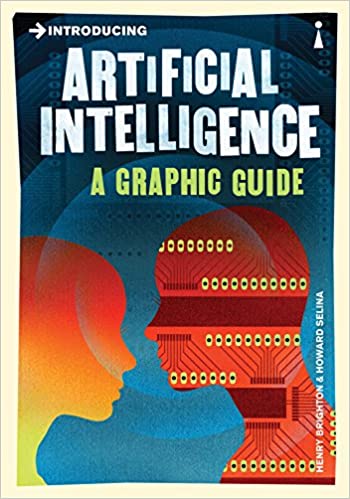
A long time ago I bought a book that I had shoved to the bottom of my technical literature cabinet. I was recently rearranging this space and found this graphically illustrated book about one of the most intriguing areas of science – robotics. The book’s called “Artificial Intelligence” and it was written by Henry Brighton. Inside is a lot of philosophically presented information about artificial intelligence, accompanied by interesting illustrations, facts and history. There are a few pages at the beginning about William Gray Walter’s turtles, which I had not heard of. I decided to do some research on the subject and the story turned out to be extremely interesting.
William Grey Walter was actually an American neuroscientist, with English roots, that mostly lived in England. He has a number of researches and contributions to medicine, but we are not interested in that right now. He was captivated by the idea of creating a machine that could reason and copy the behavior of a living organic being.
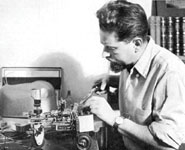
So he got to work and invented some of the first electronic autonomous robots in the history of robotics, which he affectionately called turtles. Through them, he wanted to prove that it is not the number of brain cells that matters, but the number and complexity of the connections between them. According to him, how intelligent a brain is depends entirely on how it is wired internally.

The robots he built between 1948 and 1949 he named Elmer and Elsie, but affectionately everyone, including him, called them turtles because of the appearance of their protective shell. They had two simulated neurons, enough to demonstrate complex behavior. The turtles were made from old military materials and parts of alarm clocks.
The turtles also had a light sensor, a marker light, a motion motor, and a protective shell. They were extremely rudimentary in construction, but they could still mimic some activities inherent in living organisms, such as positive phototaxis, which means that when they sense light, they move towards the light source. They were also able to imitate one of the main life activities of a single-celled animal, called Paramecium (“the slipper” as it is also called, because of its shape), which moves in a straight line until it hits something. When touching something that blocks its path, the slipper changes its direction of movement to avoid the obstacle.
So, when turned on, the robots moved around the room. When they encountered an obstacle, they changed their direction of movement to avoid it. When their battery started to die they would switch and start looking for a bright light source, always ending up in a brightly lit box where their charger was. And all this in 1949, long before modern technologies and the development of robotics.
You can see the action of the robots in THIS 2-minute long video, click to see.
And on THIS link you can see a 2-minute video of how their phototaxis function worked – or how the robots chased the light.
Walter often said, “If the actions of my robots were observed in an animal, such as a bug, it would be taken as evidence of some level of self-awareness, thought, and consciousness.”
Some later versions of the turtles were presented in 1951 at the Festival of Britain. There, and in many other places, Walter kept emphasizing how important he thought it was to use analog signals to mimic brain activity in robots, even though at the time everyone working in the field of artificial intelligence, such as Alan Turing , already worked with digital signals.
In 2000, one of Walter’s original turtles was put on display at the Science Museum in London. I hope one day I can go and see it live. Today, Walter’s turtles are considered to be one of the first autonomous robots that explore their surroundings on their own. These machines represent the world’s first true demonstration of man-made robotic life. We can call them the grandfathers of today’s robots 🙂 I also see them as the predecessors of Roomba-type vacuum cleaner robots, which today, 70 years after Elmer and Elsie, are very common in thousands of homes around the world. Walter was ahead of his time for sure. A brilliant mind.
 Technology Realm Resources