While exploring the true meaning of Valentine’s Day, I came across a beautiful sentiment that truly resonated with me: Valentine’s is about “being kind to one another and celebrating each individual for who they are, despite our differences.” 💖 I absolutely love this perspective!
In this blog post, I’ll share some creative Micro:bit project ideas that can help your classes (or you) celebrate kindness and individuality. These projects are not only perfect for Valentine’s Day but can also be easily adapted to highlight what makes each of us unique. Let’s spread some love and creativity! 💡❤️
Project idea 1: Beating heart ❤
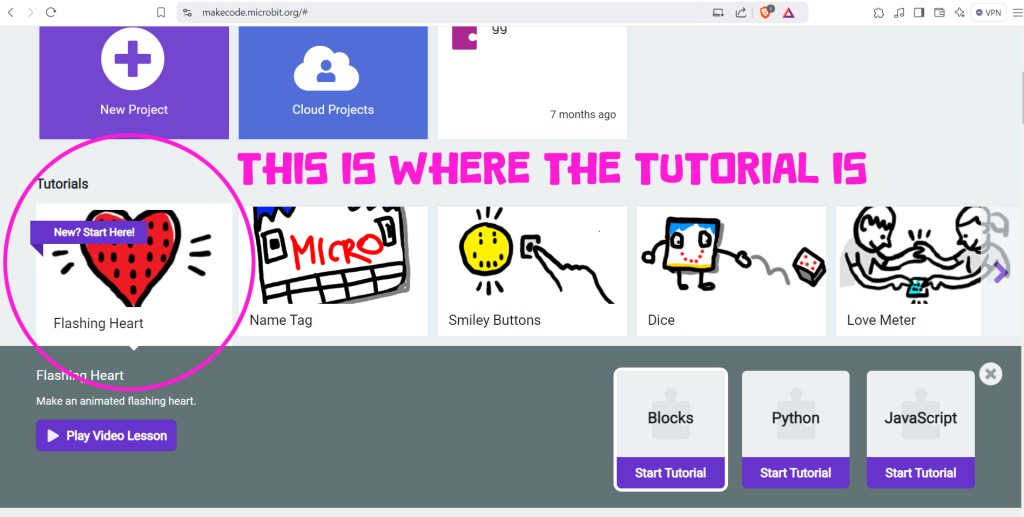
You can’t really call yourself a Micro:bit coder without tackling the classic beating heart project! 💓 It’s a beginner’s staple in the microbit world that I always use for the first or second microbit coding lesson with my students. Head over to MakeCode and explore their tutorial.
Don’t forget to remix the code and make the beating heart uniquely yours—what would your heartbeat look like after a tough workout or some calming breaths? Have a little discussion with your students about that. Do they know anything about our most important organ? How it works and why it does things?
Want to take it a step further? Dive deeper into the heartbeat theme with a hands-on lesson where students measure their own heart rate. Bring a cheap measuring tool that you can buy at any pharmacy/drug store or tech shop. Ideas of easily found such tools:
- a smart watch always has a heart rate monitor app built in
- pulse oximeters are a cheap and easy to find little gadget
- manual measuring using your wrist and two fingers – they find the pulse (feeling it), start a timer for 10 seconds and start counting the beats. After that, the number of beats for the 10 second period is multiplied by 6 and you get your BPM (beats per minute)
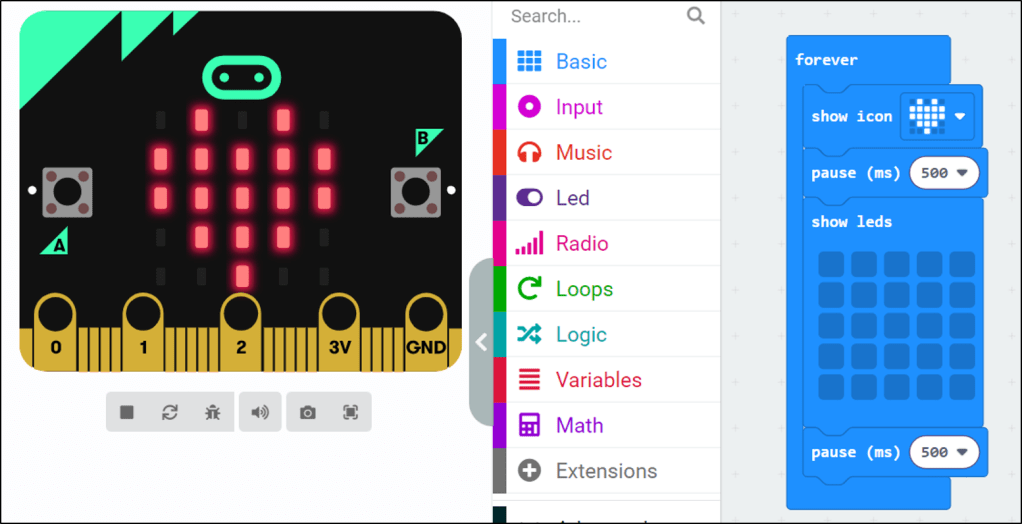
Tell the students to use a timer in their code, or a pause between the heart animations, to highlight the change of the rhythm. Bigger pauses between the changing animations would mean a slower beating heart, a calmer heart, while the opposite would mean a fast pace of beating (like while running or swimming). Here’s an example:
This project beautifully ties STEM to health, wellness, and physical education, making it both engaging and educational. 💡❤
Project idea 2: Animated Valentine’s Messages ❤
It’s very simple and perfect for absolute beginners in microbit coding. Just display scrolling Valentine’s messages like “Happy Valentine’s!” or “Be Mine ❤️” on the LED screen. The text will scroll left because the LED matrix of the microbit is too small. An option for further complication of the program would be to trigger the scrolling text with the press of either button A or B (or both), or to display a different thing on each button. Example: Button A shows “Be mine” and button B shows an animation of a heart.
Project idea 3: Random compliment generator ❤
This project turns your micro:bit into a Random Compliment Generator, designed to brighten your day with personalized, techy compliments! The micro:bit uses its coding magic to generate a random number between 1 and 12 and then displays that number on its LED screen. Depending on the number, the student receives a special compliment for Valentine’s day from the cute little BBC micro:bit. The student simply needs to refer to the table below to find the compliment that matches their number. Here’s the table I designed for my lessons, feel free to use it in your lessons as well!
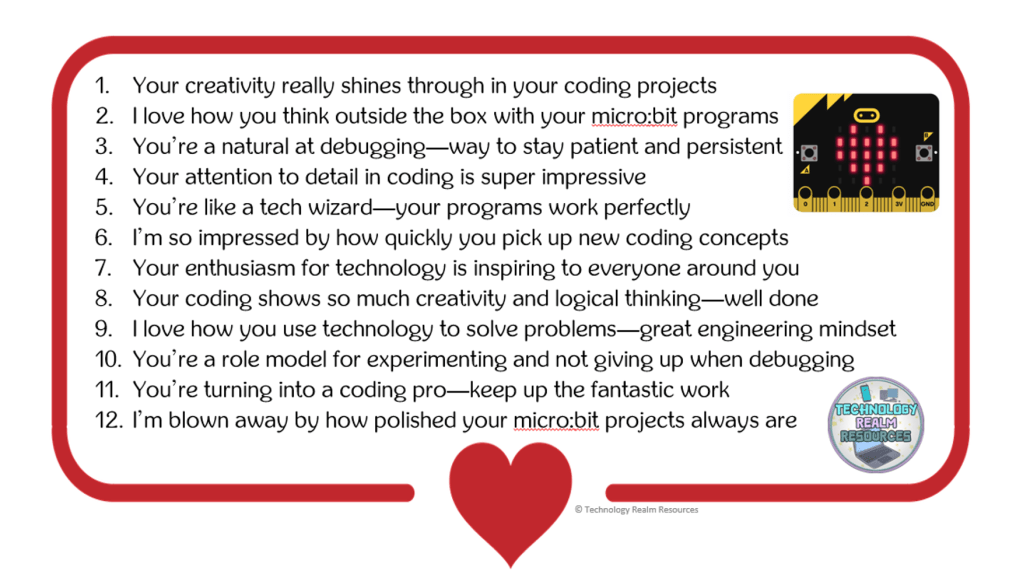
This activity blends creativity, technology, and kindness into one fun Valentine’s Day project. Students not only practice coding with variables, random numbers, and displays but also share encouragement and positivism with each other. It’s the perfect mix of STEM and social-emotional learning.
These were my 3 project ideas for Valentine’s day this year! So grab your micro:bit and some Valentine’s cheer, and get ready to code a little kindness into the students’ day! Who will get the next compliment? 😊
Happy teaching!
 Technology Realm Resources